
- I’m never going to get to be Batman.
- Life takes practical, unplanned paths that take us away from our childhood dreams.
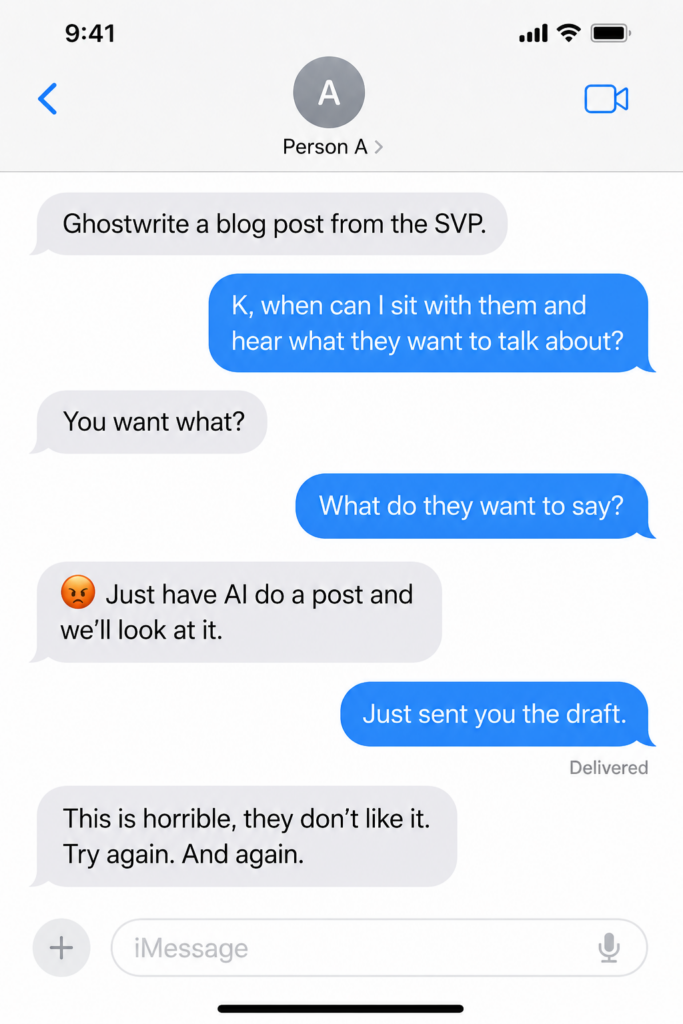
- Today’s executive thought leaders aren’t bringing the kind of personality and original thinking to bear that leads to breakout visibility and influence.
- Executives are burying what they really think, the stuff that AI search loves.
- The ideas that can revolutionize industries and better the world must be expressed.
Why I Want to help Thought Leaders
Sometimes I think about the things I wanted to be when I grew up. And why.
- Batman – I wanted to protect innocent people.
- Astronaut – I wanted to discover things.
- Air Force pilot – I wanted to be like my dad.
- Journalist – I wanted to hold truth to power and be the first to report the truth, no matter what that truth was.
Oh well
Well, I didn’t become Batman (turns out he’s fiction), an astronaut (I at some point decided I wasn’t smart enough, probably not true), or an Air Force pilot (inner ear problems). I did become a journalist, but only to find out journalism was no longer about holding truth to power or reporting the truth, no matter what it was.
I wound up being an entertainer on the radio, which while not an original goal, was fun, fulfilling, and suited my talents.
Pivot! Pivot!

Then I wound up in digital media and content for brands. Never sought it. Never wanted it. But my skills transferred over to it, and it paid really well.
I think for most of you reading this, life took a practical, unanticipated path that never represented your childhood “dreams.”
But that’s okay. Change is inevitable. And as fast as our society and technology change now, pivots, agility, and open minds are mandatory for survival. As long as I’ve been at this, I still tend to think about what’s ahead vs. mourn what was lost or never was.
To that end, I thought a lot about where I could be of the most use at this stage of my life.
What next?
All arrows pointed to running branded podcasts, which I did and still do. But it was clear to me that was tactical. There was a larger need that existed in the strategic space…thought leadership.
But not the generic, consensus-repeating stuff that most thought leadership is. My whole life was an education in the media power of personalities. And I didn’t think today’s executive thought leaders were bringing the kind of personality and original thinking to bear that leads to breakout visibility and influence (and traffic, and sales).
Executives are burying what they really think, making themselves not worthy of reading.
As someone who frames everything published as a “show,” my work seeks to extract what executives REALLY think, their worldview, opinion on what’s needed in their industry, what can be done better, hard lessons learned, what the future should look like, what the industry is getting wrong, etc.
Why does it need to be extracted? Because in business-land, we’ve been trained to be soft, safe, and sanitized. “Slick” business communication means using lots of words to say absolutely nothing.
In the war for attention, that’s certain death. Executives are burying what they really think, making themselves not worthy of reading. AI search will punish this kind of uninteresting content.
A process for Thought leaders
Once I get executives to admit what they believe, the next step is to make distinctive personalities of them. I don’t want to change them or create something contrived. But it does take some work to “uncommoditize” them so they sound distinctive in their language, tone, and framing. AI search is also very big on identifiable voices and framing.
Then I create a playbook so that anyone in their marketing department with a hand in the executive’s thought leadership content knows the show, the character, and the guidelines. Executive thinking should never be automated, but this way, what’s appropriate to scale can be.
Is Mike happy?
I do find this work fulfilling, and here’s why.
I’ve had my time on camera, on the mic, and on stage. I’m super content that I’m not going to change the world.
However… people leading business, politics, and entertainment today are very much in a position to help change the world. And helping them, crafting how they present to the world, being an advisor, is how I continue to contribute in relevant ways.
I believe many of the ideas that will get us there are sitting unspoken in a lot of executive heads.
Like many people, I’m a fan of Simon Sinek and his framework of starting with your “why.” That’s my why.
I look around and see opportunities to do things so much better, to be better, to boldly revolutionize. And I believe many of the ideas that will get us there are sitting unspoken in a lot of executive heads. Their ideas will help the childhood me protect the innocent, discover things, honor my dad, and deal in truth.
Here’s to the executives who are thought leaders in name only who want to reach their true potential and help all of us.
Who said this?
I’m an executive presence developer. I work with executives to hone a unique POV for breakthrough thought leadership content, then get their team ready to perpetually execute on it across channels and formats.
Mike Stiles