
Healthcare professional taking a patient's pulse, illustrating whether or not thought leaders have one.


  • Most thought leadership content is too careful to lead anything.
  • Being safe and instantly forgotten is not doing a “good job” as an executive.
  • So what if you publish something somebody disagrees with? Good!
  • Is there a real you? Is that who shows up in your content? 
  • AI search is deciding what your brand is right now, with or without you.

Wanted: Thought Leaders with a pulse

Safe…it’s the new invisible!

If we’re being honest, most of today’s “thought leadership” from executives, founders, experts, whatever…doesn’t exhibit much thought, and it’s not really leading anything.

It’s very careful. Careful not to upset any apple carts, careful not to show any doubt or vulnerability, careful not to show any emotion, careful not to say anything that might make anyone uncomfortable, careful not to say anything someone might challenge.

You know…skull crushingly dull.

And while there’s a sense of safety your content is wrapped inside a great big condom, executive content that sounds written by committee, neutered by legal, and approved by someone who prides themselves on their fear, is going to turn around and bite you in the ass.

why so many leaders are afraid to lead

Somewhere along the way, executives became convinced being “professional” meant being less…human. They’ve modeled themselves on politicians who consider being fake a craft. So polished, so perfect, so measured, so adept and using lots of words to say nothing.

They stopped thinking out loud, being squeaky wheels, telling stories of things that happened to them and what they learned, stopped admitting mistakes, stopped pushing us forward and helping us dream. They started considering parroting safe observations in a toneless voice a “good job” at being an executive.

You may have noticed the public is washing its hands of politicians. They’re bankrupt of trust, and executives are close behind.


The hysterics want you to be safe, not make any waves, blend in. They’re killing your brand.

Why so serious?

Let’s play this out.

You publish something thoughtful. Someone disagrees. Good!

Everyone in the building might overreact and go hysterical, but what you’ve done is get people actually paying attention, during a war for attention. You’re right, the hysterics are wrong. They want you to be safe, not make any waves, not rock any boats, and blend in. They’re killing your brand.

The executive thought leadership content getting put out today gets scrolled past, fast. If people want to suck up to you, they might click “Like,” but often without even reading what you said. This isn’t thought leadership, it’s politely disappearing.

Um – you already got the job

Why are you writing like every executive who’s ever been on LinkedIn or in a company newsletter? Is there a real you?

You’re in the role you’re in because you’re qualified and you’ve got a brain in your head. Now tell me something that only you could say. And say it with confidence.

What you know, what you think, and your real personality aren’t liabilities or land mines, they’re your distinctive competitive advantage. But not if you hide it. Who are the business leaders you remember? Are they the safest people on the internet, or are they captivating and sometimes catch flack for being so?


If all AI search finds is interchangeable corporate messaging, you have more than earned your invisibility. 

I’m not saying to always be controversial. I’m saying say what you think. Controversy’s not the goal, recognition is. The slick, polished, and safe aren’t leaders. They’re just people keeping a seat warm.

Blending in isn’t caution, it’s suicide

Was the road to your position easy? No. You spent decades going through fire and learning. Then you publish “People are our most important asset.” Come on.

Yes, there was a time SEO trickery and keyword-stuffing used to do your brand some good. But now Google, and definitely AI search, are trying to answer, “who consistently demonstrates real expertise?” Authority, originality, consistency, clarity, semantic association, reputation…none of that is optional anymore.

AI search is forming its opinion of you right now. With or without you. It looks well beyond channels you control. If you don’t have interesting ideas being cemented across channels and formats, you are not going to like the identity graph around you. If all it finds is interchangeable corporate messaging, you have more than earned your invisibility.

AI, and the communications teams that have surrendered their cognition to it, have gotten really good at generating that interchangeable corporate messaging. Don’t let your thought leadership succumb. AI recognizes AI slop, and hates it, and hides it.  

your ideas and opinions are worth fighting for

Think about “famous” people. Musicians, actors, even reality stars and influencers. They’re known for something. It’s a prerequisite.

What are you known for?

It’s not a trick question, but the answer can’t be your title. What idea(s) are you known for? What do people think when they think about you? Do they think about you?

Ironically, AI has increased the value of being unmistakably human. That’s what connects, that’s what triggers emotion, that’s what motivates action, that’s what builds relationships, that’s what builds trust.

So how “human” are you being in your content?

What I don’t want you to do is waste this opportunity in which the business world is starving for real leadership. Don’t waste the position you’ve earned. Don’t waste the pain and lessons that got you there. Don’t waste your intuition. Don’t waste your ideas and opinions. Don’t waste this stage you temporarily have (and EVERYTHING is temporary).


Who said this?

I’m an executive presence developer. I work with executives to hone a unique POV for breakthrough thought leadership content, then get their team ready to perpetually execute on it across channels and formats.

 

Embarrassed woman with fingers pointing at her because she was caught doing bad thought leadership.


  • There is no value in content that has no value.
  • Voices that are distinct and full of character get elevated.
  • No one owes you their time and attention just because you published something.
  • Most people don’t want to look bad, but way too many executives don’t seem to mind.
  • If you hate this article, that’s fantastic.

Caught Ya: AI Exposes How Little Thought Leadership There Really Is

A funny thing happened on the way to executives pushing out content about how great AI is, often written by AI. AI turned right around and exposed them for not having captivating or original thoughts.

Do you feel content getting less and less valuable?

We’ve all been subjected to this content. LinkedIn, YouTube, even major business publications are choking on it. Collectively, it’s making business content on all these platforms boring and imminently skippable.

Don’t blame AI, or even old school SEO. This sameness and lack of vision and personality was there long before AI came along. The fact that first Google, and then AI search, started rewarding content that said something new, or elevated voices that were distinct and full of character in the way the ideas were framed, just makes getting by on pablum less viable.

And don’t lie to yourself, it is less viable.

No one owes you anything

Too much executive communication and thought leadership has been nothing more than marketing copy. Yeah, we know you like your company. We know you think your product/service is better than seedless watermelon.

ALARM BELL: Your audience of prospects and customers (the audience is not you, or the people you pay to also like your company, and not your spouse) don’t obsess over what you’re selling all day every day like you do. They don’t owe you a thing, including their time and attention.

That attention (and you may have heard we’re in a war for that) has to be earned. If the Supergirl movie taught us anything, it’s that you can’t just put out something lame expecting everyone to go see it just because you put money and effort into making it.

Looking lame is not acceptable

So here you are, a big-time executive, and not only is your brand pushing out stuff just to say you did and to make the internet a little bigger, you’re allowing your name to be put down as the author of some of it. Are you nuts? Most people don’t want to look bad.

A friend of mine, who is in marketing and content, just returned from a conference in London. Now you would think that to be chosen to be on a panel or speak at a conference, the presenters would have some takeaways. But just like the internet has become, every single session was the same message all attendees already knew: AI is here to stay, it’s amazingly useful, but there’s still some human element that should remain in the work.

Oh…my…God.

Just stop doing it

Even if you aren’t writing your own executive content and you have your marketing people doing it with almost zero input from you, if it contains any iteration of…

“I’m excited to announce…”

“Innovation has never been more important…”

“People are our greatest asset…”

“Here are five trends shaping our industry…”

…please stop. We have that article already. 30,765 times.

If the goal of your thought leadership is to never say anything that will challenge anyone or that anyone will challenge, anything objectionable, anything not safe & sanitized, anything interesting or memorable, then just don’t. Either that or explain to us how “invisible” is strategic.

What AI search cares about

AI has industrialized generic content, and is turning right around and punishing it by making sure your generic content remains ignored. Congrats, you’ve made mediocrity faster and more efficient.

LLMs want to know:
Who consistently demonstrates real, and not parroted, expertise?
Who has a point of view that can’t be found anywhere else?
Who is repeatedly associated with a topic?
Who frames their original ideas in a voice and terminology that can’t be copied (semantics)?

Why do I say you shouldn’t sound like marketing copy? Marketing exists to persuade. It’s needy and often smells desperate. Thought leadership exists to interpret, teach, explain, forecast, make sense of things, help as an ally. It has a special sauce containing both empathy and swagger.

I want to know:

  • What have you seen that others haven’t?
  • What have you changed your mind about?
  • What do people in your industry keep getting wrong?
  • Where have your scars given you better judgment?
  • What can you no longer stay silent about?

The executive thought leadership challenge

Your experience is a major piece of your competitive advantage. Why bury it in favor of an entry-level marketing person using AI to draft up some BS that your name will go on and that you will be judged by? All AI does is summarize consensus. We don’t need your “Me too.”

Consider trying this:

  • Quit trying to sound like a slick, polished executive.
  • Sound like you.
  • Be recognizable.
  • Have opinions.
  • Tell stories.
  • Be challenging.
  • Be transparent and vulnerable.
  • Call things out.
  • Say something worth remembering.

That’s how authority is built.

Welcome to the age of the functioning brain

If you absolutely hated this article, I think that’s fantastic. Because I got you to feel something. You read the whole thing, and I sounded like few other people you read. You’ll remember me 10 minutes from now. You might even lay in bed wondering if I’m right.

The age of the executive leader with a brain of their own and something important to say is upon us.


Who said this?

I’m an executive presence developer. I work with executives to hone a unique POV for breakthrough thought leadership content, then get their team ready to perpetually execute on it across channels and formats.


Chess pieces lined up around the king illustrating becoming a premier thought leader.


  • Executive thought leadership isn’t marketing content with a byline attached; it’s the long-term construction of human authority, identity, and trust.
  • AI can mass-produce competent content, it can’t replicate lived experience, conviction, personality, or original perspective.
  • AI visibility belongs to executives strongly associated with ideas, language, expertise, and human insight — not volume.
  • When thought leadership fails, it’s because the executive’s own thinking never enters the process.
  • In an AI-saturated environment, being human, distinctive, and provocative cuts through the slop.

You can’t approach executive thought leadership like other content

Isn’t it exciting!? We can use AI to go get what everybody else thinks, write content that regurgitates it at scale, put our brand’s name on it, then push it out to all the suckers who chose to follow our channels.

And you know what? That might even work for commodity marketing. Firehose the search systems hard enough and you could get metrics that are “good enough.”

But if you’re a senior level executive, consider keeping your name off that stuff.

Yummy Corporate Oatmeal

Thought leadership shouldn’t sound, feel, or smell like marketing. It should sound like leadership. It should sound like helping. It should sound worth thinking about an hour after you’ve read it.

The world doesn’t need to hear what AI thinks you think or thinks you should think. It wants to hear what you really think. And while a lot of the thought leadership content right now is competent enough, too much of it is downright indistinguishable. Want to be invisible? Sound generic.

It’s an issue brands and leaders are having to get more serious about.

2025 Edelman-LinkedIn B2B Thought Leadership Impact Report: thought leadership is now considered a strategic trust-building tool by nearly 2,000 surveyed professionals and decision-makers.

But what are marketers doing? Pushing AI-generated content harder than ever and lumping thought leadership content in with it. (It’s not always their fault…leadership is ordering them to make more bad AI content).


The world doesn’t need to hear what AI thinks you think or thinks you should think. It wants to hear what you really think. 

The result? “Corporate oatmeal” with a senior executive’s name on the byline. Trust and reputation-damaging stuff.

Pump the brakes on that, because the future of discoverability isn’t who publishes the most, it’s who’s most clearly associated with worthwhile, differentiated thinking. This just in…AI doesn’t do differentiated thinking.

What’s the difference between regular marketing content and thought leadership content?

Good question. It’s because the goals are entirely different.

Traditional marketing content is usually given the missions of:

  • getting clicks
  • ranking in search
  • supporting campaigns
  • generating leads
  • promoting products

That’s all well and good. But it’s the short game. Push this week’s priority like Rome is burning and get the bosses some results that look good asap.

The job of executive thought leadership is to steadily, deliberately build identity and authority for a human being around a topic. Success or failure will determine how everyone from prospects to media to conference organizers to recruiters will see that person.


The job of executive thought leadership is to steadily, deliberately build identity and authority for a human being around a topic. 

And oh yeah, in a world rapidly moving toward people asking AI directly about that person in a one question/one answer format, how the LLMs see and categorize an executive should be actively managed.

If you want to keep focusing on keywords and publishing frequency, rock on. But AI search wants to see authority, not just activity.

What kind of content does aI reward?

AI systems increasingly reward:

  • original observations
  • firsthand experience
  • personal stories
  • consistent topic association
  • distinct use of language
  • strong semantic association
  • reputation and authority
  • idea framing
  • (ironically) human

Super bad news for the “Whoopee, I can automate 500 LinkedIn posts” bunch.

Let the usual marketing content be for crawlers. Executive thought leadership is for building relationships with human readers. And by the way, humans have gotten pretty darn good at sniffing out obvi-AI-written copy. They know when there’s no heart behind the words.

Ascend2: 35% of B2B marketers believe original research and insight are significantly more valuable than AI-generated content for building trust and authority. C’mon marketers, wake up. That number should be much higher. 

But as for decision-makers, 75% said thought leadership motivated them to research products or services they weren’t previously considering. “5 Tips for Innovation” doesn’t get you there. A leader saying something compelling that reframes how people think does.

The senior executive’s own brain can produce provocative opinion formed by personal experience better and more colorfully than generative AI. Full stop.

Why is so much executive thought leadership content ineffective?

Easy. Because it’s BORING.

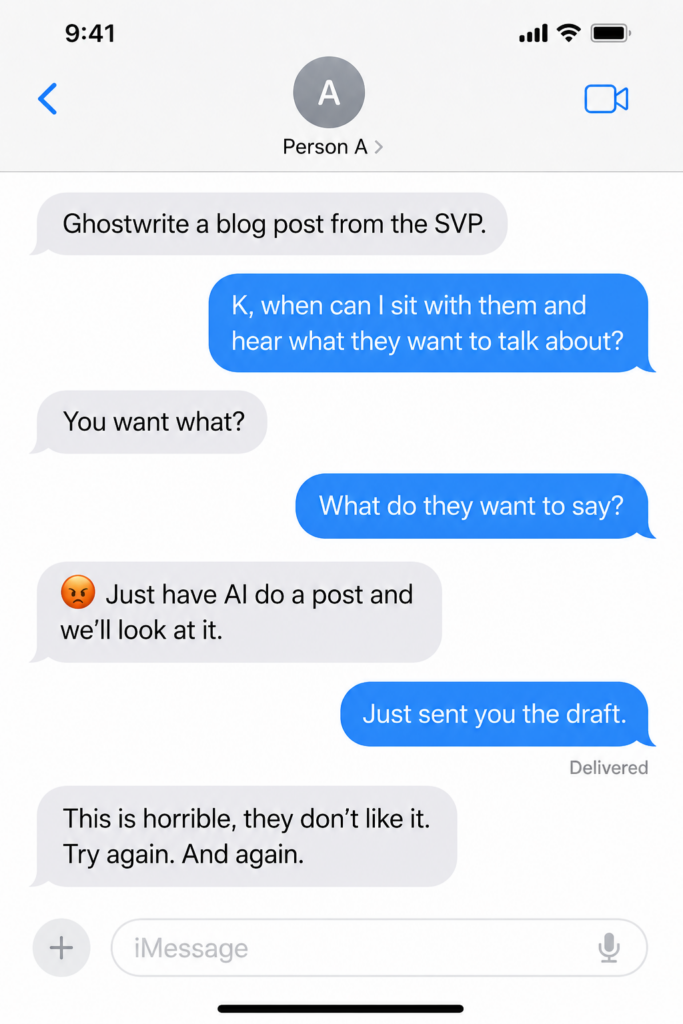
Come with me now through a day in the life of a low-level marketing staffer tasked with creating thought leadership content.

Text exchange about an executive thought leadership task

This guarantees bad content. The executive’s personality, convictions, priorities, hopes, fears, experience…none of it gets in. Not only is it boring to humans, AI search looks at it and says let’s see, no depth, no semantic distinctiveness, no presence, nothing original…hard pass.

What kind of thought leadership content works?

The kind that’s deliberate, strategic, and authentic. It’s not really rocket science, it’s just a matter of the executive running or being run through the right process: Surface. Articulate. Project.

Surface
Not all leaders carry what they really think on their sleeves. It has to be pulled out of them. They have to be asked hard questions they may not be asking themselves. Staffers aren’t the best people to extract the executive’s true personality and thoughts either. They’re careful, they’re intimidated, they don’t push back or challenge, it’s their boss.  

Articulate
Once an engaging personality and compelling, original thoughts have been brought to the surface, that needs to be organized into recognizable frameworks, language, and themes that can carry ongoing executive thought leadership content.

Project:
That quality thought leadership content can then be consistently projected across formats and platforms where AI systems and humans both evaluate authority and form lasting opinions of who this person is.

Why does personality and voice matter so much?

Hello. We’re in a media-obsessed environment. And from the newspaper columnists of old to today’s TikTokers, the strength of personalities is always what leads to success or failure.

93% (my personal made-up figure) of corporate content has no identifiable personality or voice. It isn’t immediately identifiable as belonging to that brand. When you hear Sebastian Maniscalco, you immediately know who it is you’re listening to and what to expect. You’re primed to laugh. When you watch a video from “Big SaaS Enterprises Limited,” no clue, no connection.

But here’s the bad and good news. Bad news: AI is tripling down on sameness. Good news: That makes it easier for an executive to break out of it.


From the newspaper columnists of old to today’s TikTokers, the strength of personalities is always what leads to success or failure.

You don’t even really need “star” quality. These days, if you just sound human, thoughtful, vulnerable, clear, provocative, inspirational, bold…you’ve already beaten the AI-reliant thought leadership content that’s out there.

I’ve mentioned semantic association a couple of times. That means how you, the real you, talks. Distinctive phrasing and original framing create stronger semantic associations, and that helps you out for AI visibility and executive authority. Being you…the real you…pays huge dividends, if you’re brave enough to do it.

What should executives do differently?

Get over yourself.

Stop trying to sound so polished and perfect and safe and professional. Stop hiding what experience has taught you. Stop thinking your POV isn’t worth putting out there.

Switch to sounding unmistakable. Tell your low-level marketers to go get a $6 coffee because you’re coming up with your own thoughts now. Be an active participant in how AI is going to see and present you. Because it’s already casting and categorizing you, whether you’re doing thought leadership right or not.

The executives who win visibility in the AI era will be the ones most clearly associated with differentiated expertise, recognizable frameworks, and human insight on their topics. That’s the game now. Lump thought leadership in with all the other scaled marketing content and you’re already at risk.


Who said this?

I’m an executive presence developer. I work with executives to hone a unique POV for breakthrough thought leadership content, then get their team ready to perpetually execute on it across channels and formats.

Meet with Mike


Mike Stiles, thought leadership consultant in a newsroom

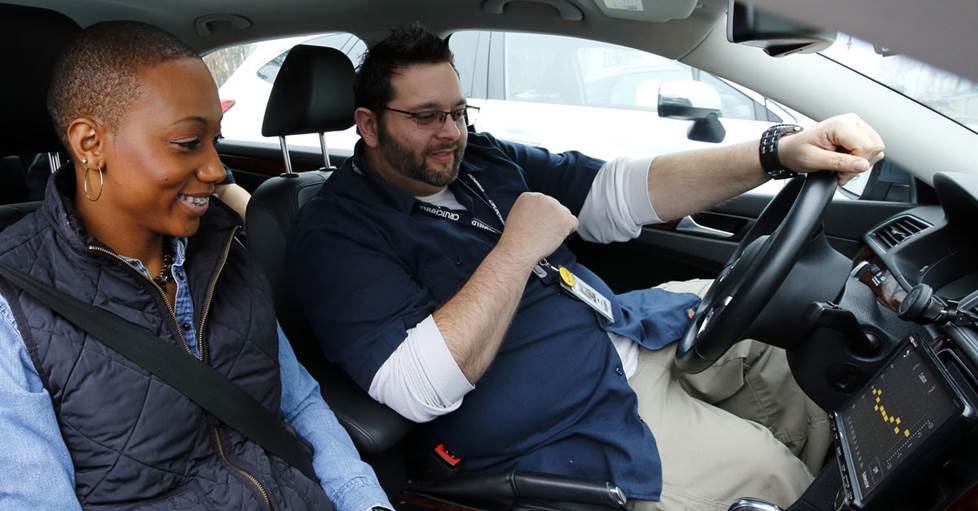
Two people in a car listening to an internal communications podcast


  • Workers in the field don’t have eyes glued to screens. 
  • Audio wins for engagement and information retention.
  • The world is embracing audio podcasts. Your workers are no different.
  • Audio can inform, align, and reduce the dreaded “I didn’t know.”

Your People Are Wired for Audio

This is just the truth: if your workforce lives in trucks, vans, forklifts, buses, or out on a job site, you can’t rely on emails, PowerPoints, or intranet PDFs to get internal messaging across. It’s not because they’re “bad employees” or refuse to read. Their brains (and our roads) are wired for movement and audio, not screen-staring in motion.

Field teams don’t live in a world of desks, keyboards, or stationary Wi-Fi. Their day looks like:

  • Steering a truck on a six-hour route.
  • Walking a warehouse floor with clipboard in one hand.
  • Standing at the back of a job site with tools in the other.

Meet Them Where They Are

Reading your internal comms on the job is impractical — and unsafe. Maybe you want them to read that stuff at home on their “free” time, but that’s just a dick move. Audio can meet them during work hours, where they already are, allowing them to get your message while working or commuting.

Audio is not some weird new comms channel nor is it a fad. It’s enjoyed mass audience consumption since the 1920’s. Here’s some recent data:

  • Roughly 40% of Americans who drove or rode in a car in the past month listened to podcasts in-car, and among cars with Apple CarPlay or Android Auto that jumps substantially.
  • Podcast consumption continues to hit new peaks, with a majority of Americans listening monthly and a big chunk weekly.

Your people are already listening to something. It’s just not you.

use Cases: What Audio Works Best For

Safety Briefings

Imagine a two-minute audio that:

  • Highlights a safety hazard before a shift drive.
  • Explains a new compliance protocol.
    Audio is clearer and better remembered than a dense PDF with bullet points.

daily Mission or Route Updates

A driver starting a day wants a quick rundown of:

  • Route changes
  • Priority deliveries
  • Weather or traffic alerts
    Audio updates can be consumed hands-free while preparing or en route.

Training and Onboarding

Field training decks read off a slide deck = instant snooze.
But an audio session from a team lead or expert talking through best practices? That’s retention gold.

Corporate Culture and Alignment

A weekly internal podcast with leadership updates, wins, and shout-outs helps make remote teams feel connected — especially when they’re not reading email threads.

Why Field Workers Prefer Audio

  • Cognitive Ease: Reading long communications while juggling tasks = user fatigue.
  • Engagement: People naturally tune into audio while they multitask (just look at how many podcasts folks squeeze into commutes).
  • Routine Fit: Audio fits into the workflows of field roles (driving, walking, prepping equipment) better than screens.

Survey data from workplace audio experiments suggest voice updates often see full listen-through rates — not a single skim — something emails can only dream of.

A healthcare podcast can be shared across not just all the major podcast platforms, but also via other existing brand-owned platforms such as your website, blog, email list, and social media channels. Plus, every single episode can be repurposed to generate additional content for your other marketing channels, which can be a tremendously efficient component of your content creation and marketing strategy.

Organizational Benefits You Can Count On

Better Information Uptake

Audio cuts through the noise. Workers hear it, and they get it. No more half-read emails scrolled past in five seconds.

Higher Retention

Humans remember stories and spoken words better than text they “kind of scanned.” It’s just how our brains work.

Staff Alignment

Audio brings tone and intent — you communicate context, not just content. That builds trust and cohesion.

Fewer Redundant Questions

When people understand instructions, they stop looping back to ask, “Wait — what did you mean?” That saves hours of managerial time.

Audio dominates in Field Workers’ World

If your internal comms strategy still leans heavily on email and decks for field and driver teams (even on site internal teams to be honest with you), you’re not just outdated — you’re leaving engagement and clarity on the table. Audio doesn’t replace every channel, but it dominates because it matches the realities of how field workers live and work.

And with podcast listening and in-car audio consumption continuing to rise, using audio is a strategic lever for real world internal communication effectiveness.


It’s Not Difficult With the Right People

I’ll work one on one with you in an a la carte manner to determine how much or little assist you need to get your brand podcast up and running or to revive an existing one. 


Blindfolded archer representing shot in the dark content strategy


  • Do you think there’s uncertainty as to the value of branded podcasts?
  • You’d be surprised how readily podcasts can keep your overall content pipeline full.
  • Authority only the human voice can have, but empowered by AI.
  • There’s a difference between a one-off experiment and a true content asset.


Branded podcasts are no longer side experiments—they’re strategic GTM content power plants. When executed right, a single podcast episode can feed all your AI-powered channels, turning your content into a cost efficient content multiplier machine.


PODCASTS = CONTENT POWER PLANTS

  • Start with one episode, create dozens of assets: transcriptions and clips → blogs, LinkedIn posts, social snippets.
  • Generate insights for bigger campaigns: topics discussed can inspire white papers, webinars, and videos that expand on the learnings (or that tie your solutions to the challenges discussed).
  • Anchor your content strategy: avoid random, reactive content that wastes time and budget.

Think of your podcast as seed content, not a stand-alone project.

aI AMPLIFIES PODCAST VALUE 

  • SEO optimization: AI can structure transcriptions into search-friendly articles.
  • Audience insights: identify which topics resonate and with whom.
  • Continuous content flow: one 30-min episode can fuel a month of posts.

With AI, your podcast becomes a content multiplier, constantly delivering ROI across channels.

BUILD AUTHORITY THROUGH THE POWERFUL HUMAN VOICE

  • Human connection matters: your voice, expertise, and perspective build trust.
  • AI can repurpose without losing authenticity: human appeal + algorithmic reach = optimal content strategy.
  • Brand authority: position yourself as the go-to expert in your niche.

REDUCE CONTENT CHAOS

  • Organized source material: every episode is an anchor for all content.
  • Consistency and efficiency: avoid duplicated efforts and maintain messaging alignment.
  • Strategic use of resources: maximize ROI on your creative output.

tHE TAKEAWAYS

Branded podcasts are GTM assets that:

  • Feed AI-powered content systems.
  • Build credibility and trust with your audience.
  • Reduce content chaos and maximize ROI.

tHREE QUESTIONS TO ASK

  1. Are my current content efforts producing assets or just one-off experiments?
  2. Could my next podcast become the engine for AI-optimized content across all channels?
  3. Am I leveraging AI to repurpose, amplify, and measure my podcast content—or just creating noise?

Depending on your answer, it might be time to reframe thinking about what’s going to be the “power plant” that fuels your multi-channel AI content strategy.


It’s Not Difficult With the Right People

I’ll work one on one with you in an a la carte manner to determine how much or little assist you need to get your brand podcast up and running or to revive an existing one. 


Girl listening to a branded podcast on her mobile device


  • Branded podcasts start with enthusiasm and good intentions, then slowly die off.
  • There’s not a realistic approach to the work and passion required to keep a great show going.
  • What’s worse than your audience asking to hear from you, and you don’t show up?
  • Podcasts can be the engine of your entire content strategy. 

Why Branded Podcasts Struggle – Then Stop


Most branded podcasts don’t fail loudly.

They just… lurch forward, then slow down, then die. Episodes get delayed. Energy drops. Downloads plateau. Internal enthusiasm fades. Then someone renders a verdict:

“Podcasting doesn’t work for us.”

Nice dodge, but the truth is tougher to admit. Most branded podcasts don’t fail because podcasting doesn’t work. They fail because of how the business ran them.

Here’s why your branded podcast might be struggling and at risk of failing.

1. no one actually owns the show

At many companies, a branded podcast is “part” of someone’s job. Nobody realistically owns it. It’s no one’s true responsibility. If it’s 10% of someone’s job, only 10% of their care, concern, attention, and passion will go toward it.

Someone should be primarily responsible for the show’s ongoing success.

Without a clear owner:

  • No one’s thinking with every episode about ways to improve the show
  • No one’s keeping the guest pipeline full
  • Episode publishing become sporadic and unreliable to the audience
  • Quality becomes inconsistent
  • No one’s evangelizing the show externally or internally
  • Metrics are reviewed sporadically, if at all

It’s not that your 10% person doesn’t care. It’s that everything that makes for a great and successful branded podcast has been minimized and deprioritized.

2. strategy is treated as a launch thing – not an ongoing discipline

Most branded podcasts launch with enthusiasm and a deck. Then the show goes live — and strategy gradually goes bye-bye.

No one revisits:

  • Whether the show still serves its original goal
  • Whether the audience definition still holds
  • Whether the structure is right
  • Whether the host is the best available
  • Whether discoverability needs tweaking
  • Whether the show is delivering for the sales funnel

Sadly, brands tend to approach podcasting like a campaign. It’s not. It’s a show, just like your favorite TV show or entertainment-oriented podcast. It’s an always-on content asset that stays good and publishes like clockwork.

Treated as campaigns, shows tire out and drift. And drifting shows don’t survive budget conversations.

3. you’re burning out your host

In many branded podcasts, the host is also:

  • The producer
  • The editor
  • The booker
  • The internal evangelist
  • The promoter
  • The person defending the show during quarterly reviews

That’s unsustainable.

Great podcast hosts should focus on networking, conversation, curiosity, presence, and value — not get bogged down in all the weeds they can possibly get stuck in.

When the host burns out, especially if the host is doing everything, the show follows.

4. consistency breaks before quality does

Most shows don’t stop because the content suddenly becomes bad. They stop because consistency erodes.

Episodes slip from weekly to biweekly.
Then to “when we can.”
Then to silence.

Consistency is one of the primary value propositions of branded podcasts. You get to say whatever you want to your stakeholders as often as you want to. Your brand gets a touchpoint with your desired audience with regularity, deepening their awareness of and relationship with you.

When consistency breaks:

  • Audiences disengage
  • Internal confidence drops
  • Pride in the show drops
  • Leadership questions ROI

Imagine someone being willing to hear from your brand twice a month, they give you that honor, and then you don’t show up.

5. success metrics were never clearly defined

Many branded podcasts launch without agreement on what success looks like.

Is it downloads?
Brand lift?
Traffic?
Sales enablement?

When success isn’t defined up front, every review becomes a subjective free-for-all of personal interests. Subjective initiatives are easy to cut.

6. the show was never integrated into a broader content strategy

Putting your branded podcast alone on an island is an incredible waste.

  • Repurposed into other content formats that populate ALL your other channels
  • Aligned with priorities and messaging
  • Used by sales, comms, or leadership

…they’ve been wasted.

The fastest way to kill a podcast is to banish it from the organization’s overall content ecosystem and content strategy. Not only does it belong in your content strategy, it’s the best tool to serve as the foundation of it.

Why this keeps happening

Branded podcasts are often launched with optimism and good intentions — but without operational reality. And without expertise. And without commitment. Somebody said, “Podcasts are easy…we can do it ourselves,” and thus doomed the show and endangered the brand’s image.

Successful branded podcasts require:

  • Editorial leadership
  • Clear ownership
  • Strategic continuity
  • Consistent execution

In other words, they need the same seriousness we apply to any long-term content investment.

So what should we do?

What struggling shows usually need is:

  • Clear accountability
  • Renewed strategic alignment
  • Editorial judgment
  • A decision about whether the show should continue

Sometimes the smartest move is to evolve the show.
Sometimes it’s to pause and reimagine it.
And yes, sometimes it’s to end it.

But those decisions should be intentional — not the result of slow neglect.

What wins

Branded podcasts don’t fail because they have nothing to bring to brands. Quite the opposite is true. They fail because no one versed in podcasting and how to run successful ongoing shows is truly responsible for making sure its potential is fully realized.

Ownership beats enthusiasm.
Strategy beats volume.
Consistency beats ambition.

Every time.


It’s Not Difficult With the Right People

I’ll work one on one with you in an a la carte manner to determine how much or little assist you need to get your brand podcast up and running or to revive an existing one. 


Woman wearing red headphone listening to organic content like branded podcasts


  • B2B buyers can only “eat” so much content
  • B2B purchases are usually significant, and require trust to close.
  • It’s humans other humans come to trust.
  • Branded podcasts are a tentpole organic content engine that can be aided by AI, but should be balanced with AI automation content.

Why Your B2B Content Strategy Needs an Organic Branded Podcast, Especially in the Age of AI


AI is exciting. But will it, by itself, build the trusting relationships that actually move B2B sales through the pipeline to closings?

REMEMBER TRUST?

AI is awesome. Marketers are throwing themselves into it and why not? It’s fast, efficient, easy, and scalable. It’s the path to the apparent dream, turning all businesses into self-running vending machines. But for those selling B2B products, services, and platforms, which are significant purchases, can it earn your prospects’ trust?

I’ll go ahead and answer as fast as AI would: Nope. At least not on its own.

In the often-reckless race to AI-automation implementation, too many B2B brand marketing operations forget that while speed and reach are powerful for pushing out more marketing assets, trust is still the currency that closes B2B deals. Sales simply don’t happen without achieving it.

But trust-building is just that, a build. And it’s consistent exposure to your human voice, your brand vibe, your POV, your expertise that best builds and earns the trust of your customers, prospects, and stakeholders.

That’s the crux of “The Balance,” a new free, no email required white paper that breaks down how marketers can tap AI’s muscle to assist and better leverage the human connection that only organic content can deliver. And why the engine of that human content should be a branded podcast.


Can’t Wait?

Would love for you to read on, but if you have a plane to catch, you can go ahead and…

Download The Free Paper


THE MODERN B2B BUYER IS SUFFOCATING ON CONTENT

Every day, your prospects are hit with somewhere between 4,000 and 10,000 marketing messages.

B2B buyers are exhausted. Forrester reports 75% of them are taking longer to make decisions due to information overload and “content fatigue.” Translation: even your best, most worthy, most convincing stuff is probably being skimmed or skipped or “saved for later” (never).

It’s time to stop acting like a pop-up ad and start acting like a trusted voice.

EVEN AS BOTS WORK HARDER TO FOOL PEOPLE, TRUST IS A HUMAN GAME

Generative AI can truly amaze. And maybe it can do everything you need done…provided your brand has no unique point of view, story, perspective, experience, values, “why,” or anything a prospect could grab onto to start feeling some sense of care and connection.

According to Gartner, sales and marketing now influence just 32% of a B2B buyer’s journey. The rest? It’s internal conversations, peer recommendations, and independent research. That means your authentic content better be out there reaching people and working long before your sales team ever makes contact.

Trust isn’t built with auto-filled first names and hyper-personalized subject lines. (Did you really think your targets aren’t savvy enough to know they’re getting impersonal personalization?) It’s built with connections made between human beings over time. You can’t scale that with account reps, but…

WHY BRANDED PODCASTS CRUSH IT

Still think podcasts are just for true crime junkies and conspiracy theory bros? Think again.

Over 584 million people now listen to podcasts, a number climbing to 650+ million by 2027. But here’s what really matters: podcast listeners pay attention. They stick with content longer. They form a bond with the hosts. And 63% of them have bought something they heard about on a podcast. 63%! Yes, that’s mostly B2C products sold in host-read ads, but that’s crystal-clear evidence of the trust a show can engender.

If your brand hosts the conversation, your buyers hear your voice, literally. That voice becomes familiar, comfortable, welcomed, trusted.

oRGANIC CONTENT DOES WHAT OTHER CONTENT CAN’T

Nobody is asking you to stop doing the blogs, webinars, social posts you’re already deeply bought into. But branded podcasts:

  • Break through. While others fight for clicks on a LinkedIn feed, you’re having a 30-minute, seemingly one-on-one chat that goes directly into someone’s ear.
  • Humanize your brand at scale. Each episode, multiple listeners that matter to you, getting a gut feel for who your brand is.
  • Leverage the desire to multi-task. Listens happen on commutes, during workouts, while walking the dog, doing chores, etc.
  • Keep your channels flush with content. Every episode generates material that becomes blogs, social posts, newsletter content, email content…a perpetual engine that populates all your marketing channels.
  • Generate leads. Exposing people to your brand by having them on as guests, sharing clips, building an online community of listeners, driving traffic to the show landing page. Your show is a warm lead machine.

THE AI + PODCAST POWER COUPLE

This isn’t an either/or situation. Keep using AI how you’re using it or plan to use it. But make sure there’s also an organic trust engine as well, one that AI can help facilitate and take maximum advantage of. AI can be the muscle, while your podcast is the heart.

GET THE PAPER

I wrote “The Balance” because I see too many eyes blazing with AI and automation excitement (or compulsion), and the reputation of humanness and organic content for actually closing B2B sales being forgotten or diminished. I think sales and closing deals is still what matters.

In the paper, I go over:

  • The pressing concerns of today’s B2B marketer and how branded podcasts speak to every one of them
  • Why buyers buy
  • A primer on branded podcasts with examples of brands who’ve been doing it for years
  • Stats a-plenty
  • The AI/Organic relationship
  • Seven different ways branded podcasts serve organic content strategies
  • A plan

I’ve made “The Balance” free, and I don’t even require you give me an email address to get it. That’s because this message is important to me and I trust that if you want to talk afterward, you’ll contact me without me spam emailing you. I’m silly that way.

Download The Free Paper


It’s Not Difficult With the Right People

I’ll work one on one with you in an a la carte manner to determine how much or little assist you need to get your brand podcast up and running or to revive an existing one. 


A political candidate speaking in front of a large crowd illustrating that podcasting for politicians can be a powerful tool.


  • 2024 proved how effective podcasts are
  • Six big advantages of using podcasting as a candidate or to drive issues
  • The ways advocacy groups are using podcasts
  • Why podcasts give you a huge awareness head start long before any campaign


PODCASTING: tHE INFLUENCE MACHINE


The 2024 election cycle demonstrated the enormous, previously untapped power of podcasts as a direct, effective, and highly personal means for candidates and advocacy groups to connect with their audiences. Podcasting for politicians and to promote issues is here to stay. 


As traditional media continued to fragment and social media became increasingly unpredictable, along with trust issues, podcasts emerged as the platform for longform, organic, authentic, nuanced discussions that built trust, credibility, and newfound support.


Candidates who adopted podcasting early in their campaigns gained a significant advantage by fostering deep relationships with their audience, solidifying their messaging, and staying in front of voters consistently. Meanwhile, advocacy groups used podcasts to drive home their policy messages, mobilize supporters, and create ongoing engagement beyond just election, legislative, or fundraising seasons.


In short, podcasting roared onto the scene as an indispensable tool for political and advocacy communication. Staying silent is no longer viable.


THE UNIQUE ADVANTAGES OF PODCASTING FOR POLITICIANS AND ADVOCACY GROUPS


  1. Building Trust and Credibility

Podcasting offers an unfiltered, intimate format where candidates and advocates can speak directly to their audience, free from media spin or soundbite culture. A well-produced podcast allows leaders to:

  • Share their vision in-depth.
  • Address misconceptions and criticisms head-on.
  • Showcase their personality and values authentically.


  1. Establishing Regular Touchpoints with Constituents

Unlike sporadic campaign events or social media posts that get lost in algorithmic chaos, a podcast provides a structured, ongoing channel to keep in touch with supporters. Weekly or bi-weekly episodes create a sense of continuity, keeping an audience engaged, informed, and active long before an election or critical advocacy push.


  1. Growing and Activating an Email List

A podcast is a powerful lead-generation tool. With the right strategy, each episode can drive listeners to sign up for exclusive content, event invitations, or campaign updates, significantly growing an email list. Since email remains one of the most effective tools for fundraising and mobilization, a podcast essentially becomes a content engine fueling supporter engagement.


  1. Solidifying Relationships and Mobilizing Support

Podcast listeners are loyal. Studies show that podcast audiences develop a deeper connection with hosts compared to other media formats. When candidates and advocacy leaders become trusted voices in their audience’s lives, they gain an engaged base that is more likely to volunteer, donate, and spread the word. 


  1. The “Always-On” Awareness Advantage

Most politicians and advocacy groups struggle with needing to rapidly ramp up awareness right before an election or key policy moment. This is expensive and inefficient. A podcast provides a steady, running head start in building familiarity, name recognition, and message clarity long before a campaign heats up.


  1. The Unmatched Benefits of Audio Content

A podcast is uniquely positioned among other content types because:

  • It’s a one-to-one listening experience. Unlike social media or video, podcasting feels like listening in to an intimate, personal conversation.
  • Listeners can multi-task. Listeners tune in while commuting, exercising, or doing chores—times when other media formats aren’t as accessible.
  • It doesn’t require screen time. In a world oversaturated with visual content, podcasting remains the only format that engages without demanding eyes locked on a screen.


POLITICIANS ALREADY USING PODCASTS TO THEIR ADVANTAGE


You won’t be the first. Several well-known politicians have leveraged podcasting to communicate directly with their audiences, bypassing traditional media gatekeepers and fostering deep engagement:


  • Ted Cruz – “Verdict with Ted Cruz” – The U.S. Senator uses his podcast to discuss political issues, judicial matters, and insider insights from Washington, D.C.
  • Hillary Clinton – “You and Me Both” – The former Secretary of State and presidential candidate engages in deep conversations with thought leaders across various fields.
  • Andrew Yang – “Forward” – The former presidential and NYC mayoral candidate uses his podcast to promote new ideas and policy discussions.
  • Nikki Haley – “Nikki Haley Live” – The former South Carolina governor, US Ambassador to the UN, and presidential candidate stays on the radar with talk about politics, social issues, and real life.


These politicians recognize a podcast provides an enormously beneficial platform to their brands and a way to help shape narratives in a way traditional media just doesn’t.


A POWERFUL TOOL FOR ADVOCACY ORGANIZATIONS


Beyond political candidates, advocacy organizations have embraced podcasting as a strategic asset. Whether fighting for policy change, raising awareness for industry challenges, or rallying a cause, organizations use podcasts to:


  • Educate and Inform – Providing deep dives on issues that might otherwise be misunderstood in mainstream media.
  • Highlight Voices from the Field – Featuring expert guests, grassroots organizers, and those directly impacted by policies.
  • Drive Fundraising and Action – Engaged listeners are more likely to donate and participate in campaigns when they regularly hear compelling stories and calls to action.


WHEN IS THE RIGHT TIME TO START A PODCAST?


If you’re running for office, managing a campaign, or leading an advocacy organization, the benefits of podcasting are crystal clear:


  • It establishes you as a thought leader.
  • It creates deep, lasting connections with your audience.
  • It keeps you top-of-mind long before election season.
  • It gives you a direct, controlled platform to shape your message.


HOW HARD IS IT TO START A PODCAST?


The amazing thing is that for it to be one of the most effective and cost-effective communication channels available, starting a podcast is easier than you might think, provided you have the right help. Your podcast “showrunner” should be able to make the process enjoyable and offer to handle as much or as little of the work involved as you’d like.


If you want to explore what your show could be, that talk with Mike Stiles at Brand Content Studios is no charge: stiles – at – brandcontentstudios.com. Up your profile, take control of your narrative, build your base, and drive real change.


It’s Not Difficult With the Right People

I’ll work one on one with you in an a la carte manner to determine how much or little assist you need to get your brand podcast up and running or to revive an existing one. 


Tropical scenery promoting a travel brand podcast


  • Travel is a topic people want to hear about
  • Many of the best stories are travel stories
  • Travel is an emotional purchase, and human voices trigger emotions
  • Why not be the source of your customers’ aspiration and anticipation? 


Wow you’re lucky if you’re a travel brand. You sell something people love and want. But are you talking to them about it?


YOU’RE BLESSED WITH A TOPIC IN DEMAND

Maybe you’ve heard. The podcast medium has been inarguably embraced by the public across all demographics, just as the audio medium has done for a century.


In poker, you’d make fun of someone who walks away from the game leaving a winning hand on the table. But that’s what many travel brands are doing when it comes to remaining silent and leaving the podcast marketing channel closed…even as they’re blessed with a topic their customers want to hear and talk about.


When the task is painting vivid aspirational travel stories, nothing impacts the decision to travel more than hearing others talk about their trips and everything the world has to offer. How often does travel come up in conversations you have at social occasions? Probably a lot. Pay attention to that desire people have to hear travel stories then ask yourself, “Isn’t it a little bit of a no-brainer for us to have a travel brand podcast?”


WHY A TRAVEL BRAND PODCAST

As promised in the title, here are just five reasons you should consider your own travel brand podcast:


1: To Foster Deeper Connections

Storytelling has driven the success of podcasting in general. But stories are particularly powerful and compelling in travel.


When a brand brings these audio “escapes” to listeners, that travel brand gets full credit for providing a fun and enticing experience even before travel is booked. And it will be the first brand thought of when it comes time to book.  


You know better than anybody that travel is an emotional purchase. And there is nothing more effective at activating emotional responses than human voices talking about travel experiences and opportunities.


Example: A boutique hotel in Paris could produce episodes centered on romantic getaways, recounting real love stories that took place on their grounds. And by the way, these stories can be real or fictional, as long as they take place in or near your brand.


2: To Capitalize on Niche Markets

One of the superpowers of podcasts, which would definitely apply to a travel brand podcast, is that shows are targeted to niche audiences.


You aren’t trying to publish the most-listened-to podcast on the internet. You’re creating a show that’s uniquely suited to the kind of traveler you’re trying to attract? Eco-travel? Multi-generational travel? Luxury travel? Culinary travel? The niche audience you want to build is right there for the taking. But if you don’t have a show for them…crickets.


As opposed to mass-marketed content marketing tactics, content aimed at niches traditionally get more engagement. There’s a huge difference between people thinking “this show is for everybody,” and “this show is for me.”


Example: A sustainable travel agency could host a podcast featuring episodes on off-the-beaten-path destinations that promote conservation and responsible tourism. Each episode could feature interviews with locals and environmental experts, offering unique insights into the destination.


3: To Build Trust (and Squeeze Out the Competition)

Podcasts offer a unique opportunity for travel and hospitality brands to position themselves as industry experts.


By offering valuable tips, insights, and expert interviews that your brand is uniquely suited to provide, your travel brand podcast establishes you as the go-to resource for travel ideas and advice. That’s bad news for your competitors, especially if they’re ignoring the podcast marketing channel and not talking.


Write all the blogs you want. Post all the pictures you want. Humans connect with other humans. So if you’ve fixed it so they can literally hear you at regular, reliable intervals, you’ve got a trust-builder that cannot be matched by any other medium.


Example: A global travel booking platform could run a podcast featuring travel industry leaders discussing everything from travel trends to the future of digital bookings. This positions the platform as not just a service provider, but as the authority on global travel.


4: To Enhance the Customer Experience

Podcasts can serve as an extension of a customer’s travel journey.


Whether it’s providing destination guides, insider tips, or offering insights on local culture, a travel brand podcast can enhance the travel experience before, during, and after the trip. You aren’t just someone who sold them something, you’re their media travel partner.


That’s an entirely higher level of engagement that adds value, enriches the customer’s experience with your brand, and deepens the customer relationship.


Example: A cruise line could launch a podcast series offering destination previews, onboard activity highlights, and interviews with crew members and previous passengers. Listening to these episodes builds pre-trip anticipation and excitement, which is very much a part of the travel experience.


5: To Leverage the Existing Popularity of the Travel Podcast Genre

Some brands and industries have a bit of an uphill climb getting people interested in what they talk about on their podcasts. But not you. The travel podcast genre has seen significant growth, driven by a rising appetite for travel inspiration, escapism, and the desire to have experiences rather than acquire “stuff.”


According to recent data, travel-related podcasts consistently rank among the most popular in the lifestyle and culture categories. Travelers are hungry for content that transports them to new destinations and helps them plan future trips, making this a prime opportunity for brands to engage with this already interested and dedicated audience.


In other words, it’s a layup. But even a shot that easy can’t be made if you aren’t on the court.


Example: A national tourism board could create a podcast featuring local influencers and experts who share insights into hidden gems and cultural landmarks. This could serve as both a promotional tool and a resource for listeners planning their next visit.


DON’T WALK AWAY WHEN YOU’RE HOLDING ALL THE CARDS

In a world where content is king, podcasts offer travel and hospitality brands an intimate and immersive way to connect with their audiences.


By fostering emotional connections, catering to niche markets, building trust, enhancing the customer journey, and tapping into the growing popularity of travel podcasts, travel brands can not only boost their marketing efforts but also deepen customer relationships and further empower their loyalty programs.


Launching a travel brand podcast is a long-term investment (but talk to me because sometimes the assumptions about what it costs aren’t accurate) that pays off by creating consistent brand touch points, lasting impressions on listeners, and inspiration for the customers’ next adventure.


It’s Not Difficult With the Right People

I’ll work one on one with you in an a la carte manner to determine how much or little assist you need to get your brand podcast up and running or to revive an existing one. 


Exhausted person who did not get help running their brand podcasting program


  • Starting a brand podcast has never been easier
  • Keeping it going is another matter
  • It’s okay to get help to keep publishing consistently
  • A brand podcast that dies on the vine is a poor reflection on the brand


The good news is that starting a brand podcasting content marketing channel has never been easier. There are a plethora of tools and platforms available so that almost anyone with a microphone and an idea can launch their own show.

The bad news is…well it’s not even bad, it’s just news that should be seriously considered…is that while the initial steps of podcasting are relatively straightforward and do-able, keeping a podcast going and maintaining the consistent cadence needed to reap the full long-term benefits of a brand podcast is a different story.

tHE ALLURE OF BRAND PODCASTING

If you’re thinking of starting a podcast for your brand and opening up that marketing and thought leadership channel, you’re definitely thinking in the right direction.

Podcasts offer a unique way to connect with audiences on a deeper level. Again and again, they’ve proven to perform better than other media assets for attention, engagement, and information retention. Using the unbeatable influential power of the human voice, brands get to share their stories, showcase their expertise, and build a loyal community of customers, prospects, and partners. Brand awareness goes up, trust in the brand goes up, the public is being exposed to the brand more often, and episodes are stoking conversations about you.

I could go on, but you get it. It’s a winner. So it’s wild to see so many brands leaving that top performing marketing and communications channel closed.

tHE REALITY OF BRAND PODCASTING

Remember all the excitement when blogs first got going? The joke was, “everybody has a blog, including my dog.” And it was true. That was because blogs were so incredibly easy to start. But what many bloggers came to realize is, blogging consistently takes work, dedication, and effort.

The same thing is happening with podcasts. Many, many people start podcasts, only to quickly realize they don’t want to do the work of producing shows and keeping it going reliably enough that they could actually build an audience (which takes time).

But brands are a different story. Brands approached and handled their blog efforts professionally and realistically. If all the stars align as they should, they’ll do the same thing as they open up the podcast channel. They will be realistically budgeted for and resourced, so that they don’t join the long list of podcasts that inconsistently put out five or six episodes, then disappeared. If the podcast is two dudes drinking and talking about Minecraft, it doesn’t matter if it disappears. But a poor or abandoned effort by a brand can reflect poorly on that brand.

tHE IMPORTANCE OF CONSISTENCY

Consistency is key to building a successful podcast. Regularly publishing episodes helps keep your audience engaged and coming back for more. It also signals to potential listeners your podcast is trustworthy and worth their time.

Inconsistent episodes, on the other hand, tell even interested listeners the podcast isn’t a serious effort, and it can’t be relied on to consistently put up new episodes. So there’s no need to subscribe. A podcast that starts strong but fades away tells listeners, “We really don’t care that you’re interested enough in us to be here.”

IT’S OKAY TO HAVE HELP FOR YOUR PODCAST

The demands of podcasting are many, so having a podcast management and production specialist aboard makes just as much sense as having a consultant or agency assist in other areas of a business. Why should the burden be tackled entirely in-house (where many brands make the mistake of making the podcast “part” of someone else’s job) when a pro can handle as much or as little of the podcasting process as needed.

Success comes from being wise enough to not go it alone. Leveraging the expertise of a podcast management and production specialist can ensure a brand podcast remains high quality, publishes consistently, gets the attention it deserves, and brings all the benefits a podcast can bring.

A well-maintained podcast like that is going to attract an audience, build an audience, deliver reliably for that audience, make the brand look great, and generate content that can then be repurposed in numerous ways to populate your other marketing channels.

oN THE AIR

Starting a podcast is easy, maintaining one is hard. In my background of running a national radio network and hosting radio morning shows in multiple markets across the country, not delivering a new show every day was never an option. That’s the kind of discipline and dedication that should be applied to brand podcast products.

Once you have such a specialist lined up, your podcast production machine can get rolling with no worries about the show dying on the vine.


It’s Not Difficult With the Right People

I’ll work one on one with you in an a la carte manner to determine how much or little assist you need to get your brand podcast up and running or to revive an existing one.