

- Executive thought leadership isn’t marketing content with a byline attached; it’s the long-term construction of human authority, identity, and trust.
- AI can mass-produce competent content, it can’t replicate lived experience, conviction, personality, or original perspective.
- AI visibility belongs to executives strongly associated with ideas, language, expertise, and human insight — not volume.
- When thought leadership fails, it’s because the executive’s own thinking never enters the process.
- In an AI-saturated environment, being human, distinctive, and provocative cuts through the slop.
You can’t approach executive thought leadership like other content
Isn’t it exciting!? We can use AI to go get what everybody else thinks, write content that regurgitates it at scale, put our brand’s name on it, then push it out to all the suckers who chose to follow our channels.
And you know what? That might even work for commodity marketing. Firehose the search systems hard enough and you could get metrics that are “good enough.”
But if you’re a senior level executive, consider keeping your name off that stuff.
Yummy Corporate Oatmeal
Thought leadership shouldn’t sound, feel, or smell like marketing. It should sound like leadership. It should sound like helping. It should sound worth thinking about an hour after you’ve read it.
The world doesn’t need to hear what AI thinks you think or thinks you should think. It wants to hear what you really think. And while a lot of the thought leadership content right now is competent enough, too much of it is downright indistinguishable. Want to be invisible? Sound generic.
It’s an issue brands and leaders are having to get more serious about.
2025 Edelman-LinkedIn B2B Thought Leadership Impact Report: thought leadership is now considered a strategic trust-building tool by nearly 2,000 surveyed professionals and decision-makers.
But what are marketers doing? Pushing AI-generated content harder than ever and lumping thought leadership content in with it. (It’s not always their fault…leadership is ordering them to make more bad AI content).
The world doesn’t need to hear what AI thinks you think or thinks you should think. It wants to hear what you really think.
The result? “Corporate oatmeal” with a senior executive’s name on the byline. Trust and reputation-damaging stuff.
Pump the brakes on that, because the future of discoverability isn’t who publishes the most, it’s who’s most clearly associated with worthwhile, differentiated thinking. This just in…AI doesn’t do differentiated thinking.
What’s the difference between regular marketing content and thought leadership content?
Good question. It’s because the goals are entirely different.
Traditional marketing content is usually given the missions of:
- getting clicks
- ranking in search
- supporting campaigns
- generating leads
- promoting products
That’s all well and good. But it’s the short game. Push this week’s priority like Rome is burning and get the bosses some results that look good asap.
The job of executive thought leadership is to steadily, deliberately build identity and authority for a human being around a topic. Success or failure will determine how everyone from prospects to media to conference organizers to recruiters will see that person.
The job of executive thought leadership is to steadily, deliberately build identity and authority for a human being around a topic.
And oh yeah, in a world rapidly moving toward people asking AI directly about that person in a one question/one answer format, how the LLMs see and categorize an executive should be actively managed.
If you want to keep focusing on keywords and publishing frequency, rock on. But AI search wants to see authority, not just activity.
What kind of content does aI reward?
AI systems increasingly reward:
- original observations
- firsthand experience
- personal stories
- consistent topic association
- distinct use of language
- strong semantic association
- reputation and authority
- idea framing
- (ironically) human
Super bad news for the “Whoopee, I can automate 500 LinkedIn posts” bunch.
Let the usual marketing content be for crawlers. Executive thought leadership is for building relationships with human readers. And by the way, humans have gotten pretty darn good at sniffing out obvi-AI-written copy. They know when there’s no heart behind the words.
Ascend2: 35% of B2B marketers believe original research and insight are significantly more valuable than AI-generated content for building trust and authority. C’mon marketers, wake up. That number should be much higher.
But as for decision-makers, 75% said thought leadership motivated them to research products or services they weren’t previously considering. “5 Tips for Innovation” doesn’t get you there. A leader saying something compelling that reframes how people think does.
The senior executive’s own brain can produce provocative opinion formed by personal experience better and more colorfully than generative AI. Full stop.
Why is so much executive thought leadership content ineffective?
Easy. Because it’s BORING.
Come with me now through a day in the life of a low-level marketing staffer tasked with creating thought leadership content.
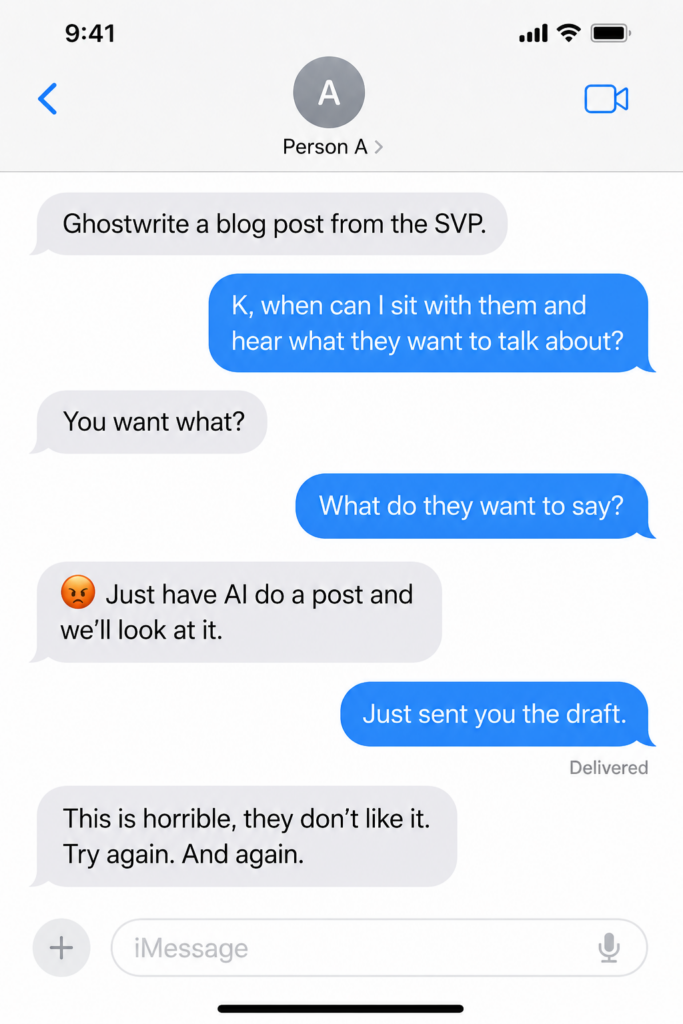
This guarantees bad content. The executive’s personality, convictions, priorities, hopes, fears, experience…none of it gets in. Not only is it boring to humans, AI search looks at it and says let’s see, no depth, no semantic distinctiveness, no presence, nothing original…hard pass.
What kind of thought leadership content works?
The kind that’s deliberate, strategic, and authentic. It’s not really rocket science, it’s just a matter of the executive running or being run through the right process: Surface. Articulate. Project.
Surface
Not all leaders carry what they really think on their sleeves. It has to be pulled out of them. They have to be asked hard questions they may not be asking themselves. Staffers aren’t the best people to extract the executive’s true personality and thoughts either. They’re careful, they’re intimidated, they don’t push back or challenge, it’s their boss.
Articulate
Once an engaging personality and compelling, original thoughts have been brought to the surface, that needs to be organized into recognizable frameworks, language, and themes that can carry ongoing executive thought leadership content.
Project:
That quality thought leadership content can then be consistently projected across formats and platforms where AI systems and humans both evaluate authority and form lasting opinions of who this person is.
Why does personality and voice matter so much?
Hello. We’re in a media-obsessed environment. And from the newspaper columnists of old to today’s TikTokers, the strength of personalities is always what leads to success or failure.
93% (my personal made-up figure) of corporate content has no identifiable personality or voice. It isn’t immediately identifiable as belonging to that brand. When you hear Sebastian Maniscalco, you immediately know who it is you’re listening to and what to expect. You’re primed to laugh. When you watch a video from “Big SaaS Enterprises Limited,” no clue, no connection.
But here’s the bad and good news. Bad news: AI is tripling down on sameness. Good news: That makes it easier for an executive to break out of it.
From the newspaper columnists of old to today’s TikTokers, the strength of personalities is always what leads to success or failure.
You don’t even really need “star” quality. These days, if you just sound human, thoughtful, vulnerable, clear, provocative, inspirational, bold…you’ve already beaten the AI-reliant thought leadership content that’s out there.
I’ve mentioned semantic association a couple of times. That means how you, the real you, talks. Distinctive phrasing and original framing create stronger semantic associations, and that helps you out for AI visibility and executive authority. Being you…the real you…pays huge dividends, if you’re brave enough to do it.
What should executives do differently?
Get over yourself.
Stop trying to sound so polished and perfect and safe and professional. Stop hiding what experience has taught you. Stop thinking your POV isn’t worth putting out there.
Switch to sounding unmistakable. Tell your low-level marketers to go get a $6 coffee because you’re coming up with your own thoughts now. Be an active participant in how AI is going to see and present you. Because it’s already casting and categorizing you, whether you’re doing thought leadership right or not.
The executives who win visibility in the AI era will be the ones most clearly associated with differentiated expertise, recognizable frameworks, and human insight on their topics. That’s the game now. Lump thought leadership in with all the other scaled marketing content and you’re already at risk.
Who said this?
I’m an executive presence developer. I work with executives to hone a unique POV for breakthrough thought leadership content, then get their team ready to perpetually execute on it across channels and formats.